
Fraunhofer-Institut für Solare Energiesysteme ISE
Booth number: 2E100a
www.ise.fraunhofer.de/en
About us
For over 30 years, Fraunhofer ISE has been supporting the development of climate-neutral industrial processes and sustainable mobility with the development of hydrogen technologies.
Our core competence lies in the development, production and characterization of catalytically active components. In hydrogen production, our focus is on electrolysis using proton exchange membranes (PEM) and anion exchange membranes (AEM). Furthermore, we focus our research on membrane fuel cells – especially for the mobility sector. Using thermochemical processes, we synthesize gaseous and liquid fuels and "green chemicals". In addition, we carry out life cycle analyses to determine the sustainability of various processes and calculate the costs of hydrogen products using techno-economic assessments.
We support our customers with highly qualified research and development services: we conduct feasibility studies, develop and test components or systems and carry out modeling, simulations and analyses from the microscale up to global energy systems. Our excellent laboratory infrastructure provides the foundation for scientifically grounded innovations.
Address
Heidenhofstr. 2
79110 Freiburg
Germany
E-mail: info@ise.fraunhofer.de
Phone: +49 761 4588-0
Internet: www.ise.fraunhofer.de/en
Products & Services
Fraunhofer ISE focuses on innovative solutions and product developments in the fields of NH₃ reforming, the production of sustainable synthesis products and the analysis of hydrogen model regions. Our experts look forward to presenting our multi-layered portfolio of innovations and services that support the upscaling of hydrogen technologies.
Power-to-X
Fraunhofer ISE offers a wide range of research services in the field of chemical energy storage. The researchers develop efficient PtX processes, conduct assessments of technology and potential, and provide support with customized catalysts. They are currently researching sustainable liquid fuels for aviation, as well as an innovative, sustainable power-to-ammonia process that increases the ammonia yield and reduces production costs. In addition, they have developed the patented INDIGO® process, an efficient and compact method for producing renewable DME from hydrogen and CO2, which represents an efficient and cost-effective process alternative and can also be implemented at locations with limited infrastructure.
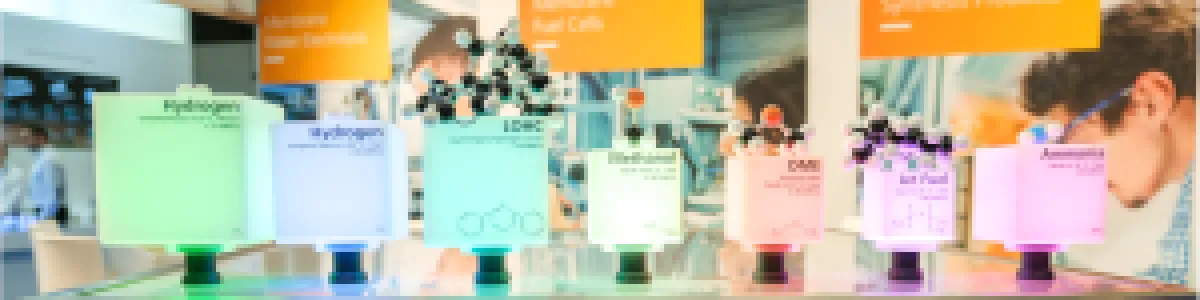
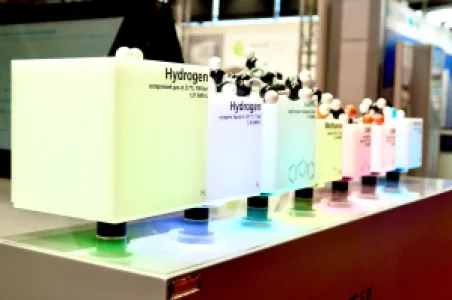
At the World Hydrogen 2026 Fraunhofer ISE’s PtX Cube displays different hydrogen-based energy carriers in terms of their relative energy density compared to non-pressurized and compressed hydrogen.
Research and development services for:
- PtX project developers and investors
- Catalyst manufacturers
- Technology and process developers
- Plant operators
- EPC companies
Analysis of Global/Regional Hydrogen and Power-to-X Production and Supply Chains
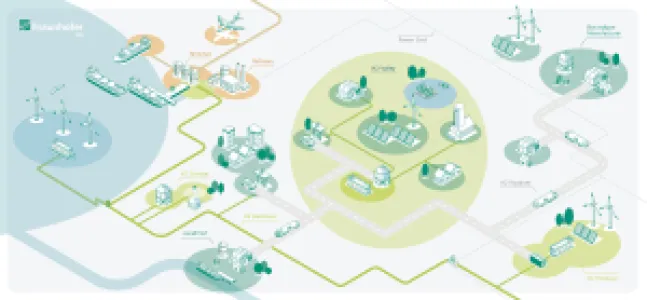
The scientists map, analyze and optimize the upgrading and construction of regional and global infrastructure and the full value chain of supply networks (from feedstock provision through hydrogen and syngas production, conversion and storage to transport) in geo-techno-economic terms. The cost-efficient, locally optimized hydrogen landscape that they develop avoids stranded assets and considers transport costs, renewable energy potential and offtake requirements. Building on a detailed data base, they calculate electricity costs for promising sites and derive the final costs of hydrogen and green molecules. They optimize synthesis and reforming processes and plants, incorporating material/energy integration and costs models. Leveraging advanced techno-economic assessments, They evaluate and optimize electrolysis systems and hydrogen-based infrastructure for performance and cost-effectiveness. Our LCA methodologies enable the comparison of processes and products under current as well as future regulatory frameworks.
At the World Hydrogen 2026 the 3D exhibit “Hydrogen Model Region” models a local, self-contained world with regional hydrogen production, distribution and storage and showcases the comprehensive expertise across the entire value chain of the department Hydrogen Technologies at Fraunhofer ISE.
Research and development services for:
Port operators / logisticians
Project planners in general
Industry in general
Public transport operators
Municipalities / cities
Ammonia Cracking
During ammonia cracking, ammonia (NH₃) is converted into its components nitrogen (N₂) and hydrogen (H₂). To enable this chemical reaction efficiently at moderate temperatures, catalysts are used. The process is endothermic and therefore requires a continuous heat supply. This heat can be provided electrically or chemically via the partial oxidation of NH₃ to N₂ and water. In large-scale industrial plants, heating is typically provided by burners that heat the reactor walls and thus indirectly heat the catalyst. ISE is experimentally investigating well-integrable, compact reactor concepts suitable for dynamic operation.
At the World Hydrogen Summit & Exhibition, the exhibited eCracker features a modular reactor design with an electrically heated catalyst carrier, enabling fast start-up in under two minutes (with further optimization in progress). With a hydrogen production capacity of up to 0.8 kg/h and an electrical power supply of approx. 4–5 kW, it can be easily integrated into existing systems and scaled via numbering-up for different power classes.
Research and development services for:
Engine, turbine & fuel cell manufacturers
Plant engineering / EPCs & system integrators
PtX project developers