
AMBARtec.de
Booth number: 4B110b
www.ambartec.de
About us
Storing energy and hydrogen and transporting it with standard logistics
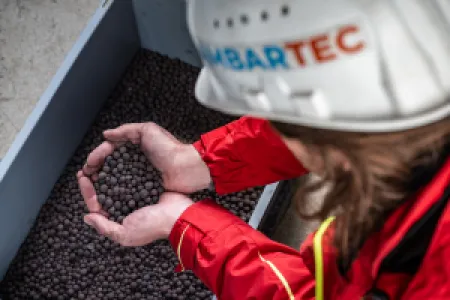
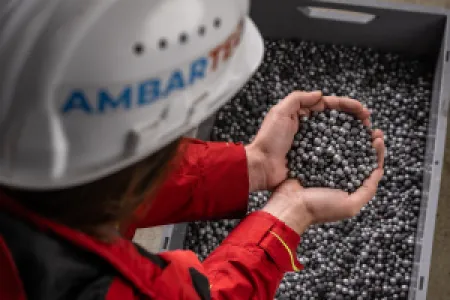
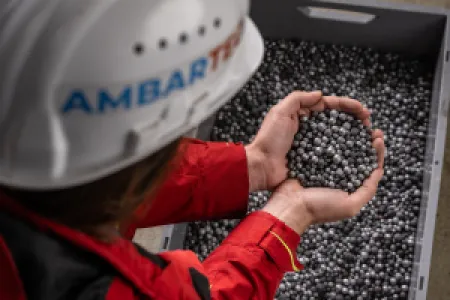
AMBARtec offers a cost-effective, safe and scalable solution for storing and transporting energy in the form of hydrogen. Our storage material are iron nuggets, making storage and transport - even intercontinental - highly efficient, safe and cost effective.
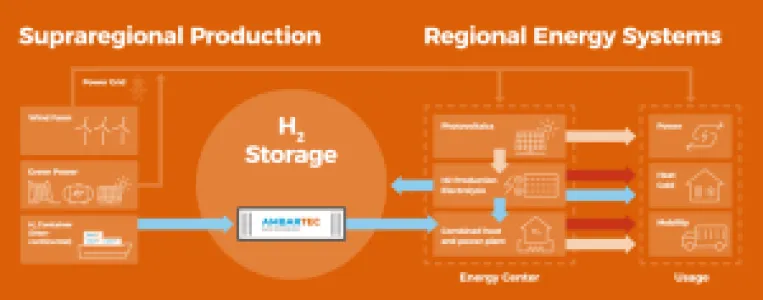
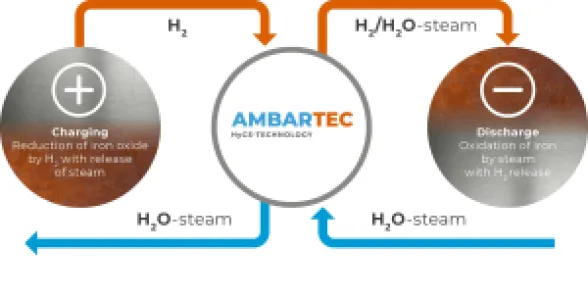
The process consists of the reduction and oxidation of iron oxide or iron: During storage, the added H2 reduces the iron oxide storage medium. The vapor released in the process can be reused in electrolysis. During discharge, water vapour is added to the storage unit at the point of use. This causes the iron to oxidise, releasing H2.
Multi-stage practical tests confirm the excellent energy balance of the entire process, from H2 production to storage unit filling, transport and discharge of the hydrogen. Optimum system integration of high-temperature electrolysis (SOEC) enables efficiencies of more than 80 per cent to be achieved.
The possible applications of the AMBARtec storage system range from highly efficient energy storage to the safe transport of hydrogen, even over long distances, and hydrogen drives in shipping.
AMBARtec thus provides the 'missing link' between hydrogen production and use, enabling the ramp-up of the hydrogen economy. To this end, the storage provider AMBARtec is now also responsible for initiating trade in low-cost hydrogen.
Address
Erna-Berger-Straße 17
01097 Dresden
Germany
E-mail: communication@ambartec.de
Phone: +49 351 30993666
Internet: www.ambartec.de
Contact person:
Matthias Rudloff
CEO
E-mail: communication@ambartec.de
Phone: +49 351 30993666
Uwe Pahl
CTO
E-mail: uwe.pahl@ambartec.de
Phone: +49 162 9097006
Dr. Ines Bilas
Head of Marketing and Communication
E-mail: ines.bilas@ambartec.de
Phone: +49 172 2341100
Alexander Liehske
Business Development Manager
E-mail: bd@ambartec.de
Phone: +49 351 30993666
Products & Services
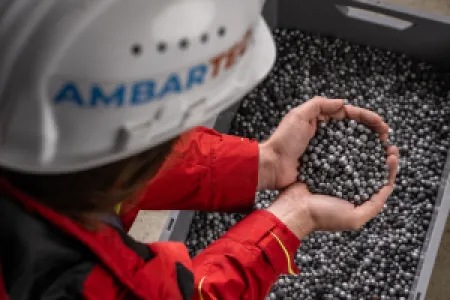
Technology to store and transport hydrogen based on iron oxide nuggets.
Hydrogen trading - supplying companies with affordable Hydrogen.
Power plants: Security of energy supply thanks to long-term energy storage using hydrogen.
Operating CHP plants with a 20% hydrogen blend.
Solutions for climate-neutral steelworks.
Technology to store and transport hydrogen based on iron oxide nuggets.
AMBARtec’s technology can be used to store and transport hydrogen (H2) based on iron oxide. I
The process consists of the reduction and oxidation of iron oxide or iron: During storage, the added H2 reduces the iron oxide storage medium. The vapor released in the process can be reused in electrolysis. During discharge, water vapour is added to the storage unit at the point of use. This causes the iron to oxidise, releasing H2.
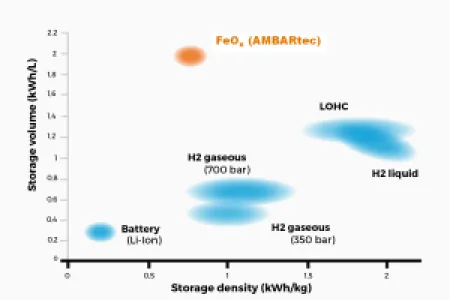
The technology offers several advantages compared to other H2 storage technologies and is more compact, efficient and cost-efficient.
- Energy can be stored safely for a long time.
- Can be transported over long distances - even intercontinental.
- Transport using conventional standard logistics, no need to adapt infrastructure.
- 100 % higher efficiency in long-term electricity storage: doubling of the ‘electricity-to-electricity’ efficiency in the entire chain ‘renewable energy generation - H2 production - H2 storage - re-conversion to electricity’ chain up to 65 %.
- Efficiencies of around 80 % for the ‘electricity-to-H2 after storage’ process, thus ‘hydrogen production - charging the storage unit - discharging the hydrogen’ through optimised system integration of an SOEC.
- Up to 30% lower H2 production costs.
- 50% less space required for H2 storage.
- Up to 90% less water required for H2 production during storage charging. The water required for electrolysis is efficiently recovered, especially during the storage charging phase. This is particularly beneficial for H2 production in sunny regions with limited water resources.
- Non-hazardous, as no hydrogen can escape from the storage systems.
- Simpler and therefore faster permit procedures.
- Market-available, low-cost and sustainable materials.
- Fast loading/unloading.
Hydrogen (H2) trading - Supplying companies with affordable H2.
Industrial companies can be promptly supplied with low-cost hydrogen using conventional standard containers - thanks to AMBARtec's loaded iron nuggets. This is usually recycled hydrogen (‘silver H2’), this means hydrogen that arises in industrial processes or at research facilities and that is not currently being used.
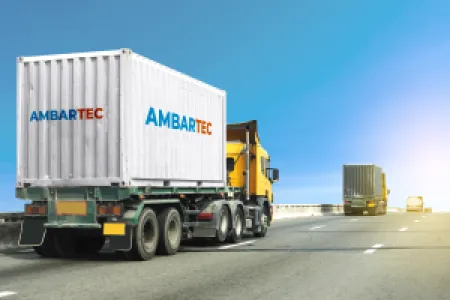
In this way, companies can prepare for the conversion of their processes to hydrogen before they are connected to the hydrogen core grid. Companies that will not be connected can ensure a continuous supply of hydrogen through long-term supply contracts. Deliveries are made by trucks and users only need an unloading unit, which is provided by AMBARtec.
- On-demand supply contracts.
- Low-cost, immediately available hydrogen.
- Prompt supply of hydrogen.
- No infrastructure changes required.
- No transport of dangerous goods.
- Nopermits required under Federal Immission Control Act (BimSchG) or Hazardous Incident Ordinance (Störfallverordnung).
- Delivery by truck.
-thumb.webp)
Power plants: Security of energy supply thanks to long-term energy storage using hydrogen.
To ensure a secure energy supply from renewable energy sources, reserves must be maintained. In Germany, this is regulated by the Power Plant Security Act.
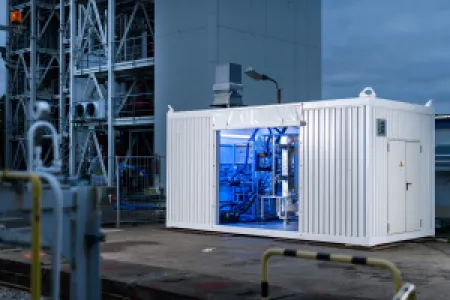
AMBARtec's storage systems are particularly suitable for the safe and loss-free storage of large amounts of energy. They store the energy of the hydrogen for any length of time. The hydrogen is only produced when it is needed. This means that our unpressurised storage tanks are not subject to the Hazardous Incident Ordinance and do not require complex security measures.
- The energy can be stored safely for a long time.
- Fast charging and discharging of the storage tank.
Low space requirement due to the very high vol. energy density.
- Use of sustainable and commercially available materials.
Operating CHP plants with a 20% hydrogen blend.
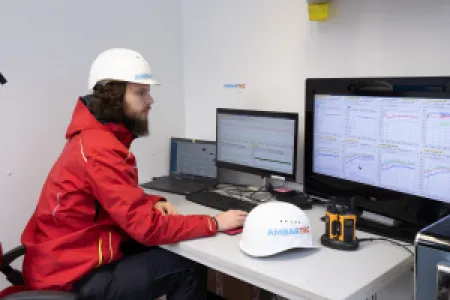
AMBARtec's iron oxide-based hydrogen storage systems enable CHP plant operators to run their gas engines with up to 20% hydrogen without retrofitting. As the storage systems are not classified as hazardous materials, lengthy approval procedures or additional special safety measures are not required. To blend the natural gas with hydrogen has only a very minor impact on operating costs.
It is also possible to purchase low-cost hydrogen from AMBARtec's partner network, which is currently significantly cheaper than electrolysis hydrogen.
- Transport using standard logistics.
- 100% higher efficiency in long-term electricity storage.
- Efficiencies of ca. 80% for the ‘electricity-to-H2 after storage’ process through integration of an SOEC.
- Up to 30% lower H2 production costs.
- 50% less space required for H2 storage.
- Up to 90% less water for H2 production during storage charging.
- Non-hazardous goods.
- Simpler and faster permit procedures.
- Market-available, low-cost materials.
- Fast loading/discharging.
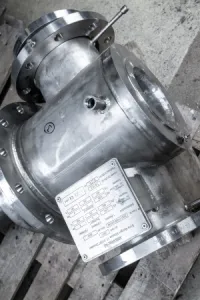
Solutions for climate-neutral steelworks.
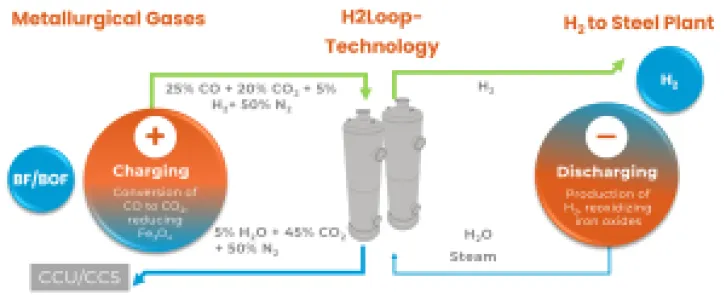
In collaboration with Rouge H2 Engineering AG, AMBARtec offers an alternative process based on iron oxide nuggets to produce high-purity hydrogen from dirty gases such as blast furnace gases and synthesis gases from biogenic residues or sewage sludge (The “H2-Loop process”). Together with CCS/U, this steam-iron process could make steelworks climate-neutral at a reasonable cost.
This two-stage process uses iron oxide (FeOx) to convert carbon-containing gas mixtures into hydrogen (H₂) and carbon dioxide (CO₂). Blast furnace gas, coke oven gas and converter gas can thus be processed to generate high-quality hydrogen.
If these gases are added to iron oxide nuggets under the right conditions, the iron oxide is reduced and carbon dioxide and steam are released.
FeOx + CO/H2 --> FeO + CO2/H2O
The high-purity carbon dioxide produced during this process can be utilised as a material (CCU) or stored (CCS). The precondition for this green transformation of the steel industry is that the CCS Act, which is currently being revised, must authorise the storage of CO2 from the steel industry. This gives the steel industry the chance to make its production more climate-friendly without having to invest heavily in converting the entire process chain. This will ensure that steel production in Europe remains competitive despite the stringent climate protection requirements.
-thumb.webp)
-thumb.webp)